Why SiennaSinks.com is the top provider of stainless steel undermount sinks.
At SiennaSinks.com we are proud to offer top quality designer undermount sinks at wholesale prices. Our sinks are a perfect addition to any high end stone countertop, such as granite, marble, quartz, or concrete in any decor or style of home.
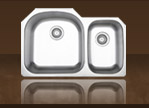
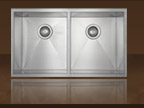
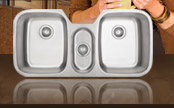
We offer over 25 different styles and sizes of undermount sinks to fit whatever your application requires. Whether you need a single bowl, double bowl, or triple bowl sink, you will find it here.
With brushed satin finishes on 18 and 16 gauge steel, our stainless steel sinks are beautiful and elegant, and are made to withstand the test of time. We use only 304 series certified stainless steel in all of our undermount sinks. Your countertops will last a lifetime, and so should your sink.
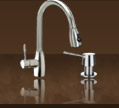
For a uniform look to accentuate your kitchen, we also offer matching designer faucets and undermount sink accessories. Our custom value pack builder lets you add matching items to the sink of your choice, and every item you add to the value pack brings additional discounts to your sink, and the accessory as well.
Why waste your money on an expensive department store undermount sink that costs twice the price? Our efficiency in marketing, business, and logistics gives us the ability to offer you high end products at low prices - and ship them to your door for free!
SiennaSinks.com makes ordering quick, easy, and secure. And if you have any questions, feel free to call us. Our staff has decades of experience in the solid surface countertop industry and we would love to answer any questions you might have about your project and installation.







 Simple care and maintenance procedures can help your sink last a lifetime.


 Single Bowl Undermount Sinks

 This is to let you know I am a plumbing contractor 35 years. And this is the best service I have ever experienced. I received the sinks on time and the quality is as good as sinks I have used for twice the money. I would recommend this company to any home owner or contractor. It was a pleasure doing business with this supplier.
 Clean regularly with a mild detergent solution and/or clean water applied with a soft cloth or sponge.
Rinse and towel dry after every use to prevent mineral deposits from building up on the surface of the sink.
Deep clean once a week with an approved cleanser (be sure to rub in the direction of the finish lines) and a soft cloth or sponge rather than an occasional aggressive single cleaning. Cleaners should state approved or suitable for stainless steel.
Clean regularly with a mild detergent solution and/or clean water applied with a soft cloth or sponge.
Rinse and towel dry after every use to prevent mineral deposits from building up on the surface of the sink.
Deep clean once a week with an approved cleanser (be sure to rub in the direction of the finish lines) and a soft cloth or sponge rather than an occasional aggressive single cleaning. Cleaners should state approved or suitable for stainless steel.
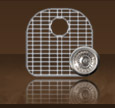
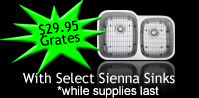 Purchase one of the four sinks below and receive a set of sink grates and a strainer with your order for only $29.95! (a $70.95 value)


